Sunday, July 5, 2015

Sheep Shearing in Glenogil, Scotland

I will admit, since coming to Scotland I have become a bit sheep obsessed.  They are seemingly everywhere as you travel around by car and by train, munching grass and giving much of the country a buccolic, pastoral atmosphere.  They look so cute, especially in the early-lamb days of April and May. 
Grazing sheep in Glenogil
Being a digital researcher, however,  I never had a reason to interact with sheep aside from viewing them as we zipped by in the car. But, being an (sheep-obsessed) anthropologist, I wanted to change that. Our friend Steven is the son of a farmer, and he introduced me to Scott, whose working farm is just up the road from Dundee. Scott mentioned that he was about to gather some sheep in for shearing in the 10 days after we met him, so I, jumping at a chance to interact with sheep up close, asked if I could come along. To my surprise, he agreed. And so, ten days later, after forty-five minutes driving into the pastoral wilderness with my husband and three-year-old (thank you, very patient husband and three-year-old, for humoring me), we were there, at Scott's farm in Glenogil, eye to eye with some uncertain sheep, and some confused workers who were too polite to ask us why we were standing around like tourists, watching them work.

Fortunately Scott arrived at that moment and shepherded us through the sheep enclosure and into the shed that was the sheep shearing staging ground. They had gathered approximately 1100 male blackface sheep from the hill the day before, starting "early" and finishing about 6 pm.  Scott told us that they gather these sheep four times a year, and that they keep around1400 female sheep closer to home, although some of the "home" sheep go up the hill to join the "hill" sheep in summer. Since the sheep to be sheared had been gathered into the barn, the first step was getting them from the barn to the shearing shed.
Scott and his father encourage the sheep in the right direction
The shearing team had arrived around 8 that morning - a team of three contractors who travel around to shear as needed.  Although they were all experienced shearers, the lead guy competed in competitive sheep shearing as well - he was quite amazing to watch. Once the sheepwere in the shed, they were pushed into a series of small pens leading up to the shearing platform.

Waiting for shearing
The chute
To be sheared, sheep were encouraged up a narrow chute.  There were three doors in the side of the chute, one for each shearer.  When the shearer was ready, he opened the appropriate door, hauled out a sheep, positioned it and held it in place with one hand, while grabbing the electric razor and beginning to shear with the other hand.

Two shearers at work on the shearing platform
 Scottish friends asked if I had a go at shearing, and the answer was, after watching the shearers wrestle the sheep, I had no desire to try my completly amateur hand at what is clearly a trained professional job. I envisioned wool carnage, if not a sliced sheep leg (or my own hand). I am just not that strong, or coordinated. Have a look at this: the lead shearer, wrestling a sheep through the shearing dance, start to finish, in 1 minute:


After the shearer fnished a sheep, he let it go, and it jumped off the plaform and scampered away.  As in the video, someone gathered up the fleece and moved it out of the way, so the shearer could keep his rhythm going.  This fleece-gathering was about the only job Paul and I were qualified to do here.  It involved spreading out the fleece, rolling it up, and putting it in the bag of fleeces.

Finished sheep: note bag of fleece in the foreground

Rolling the fleece


Paul with his rolled fleece
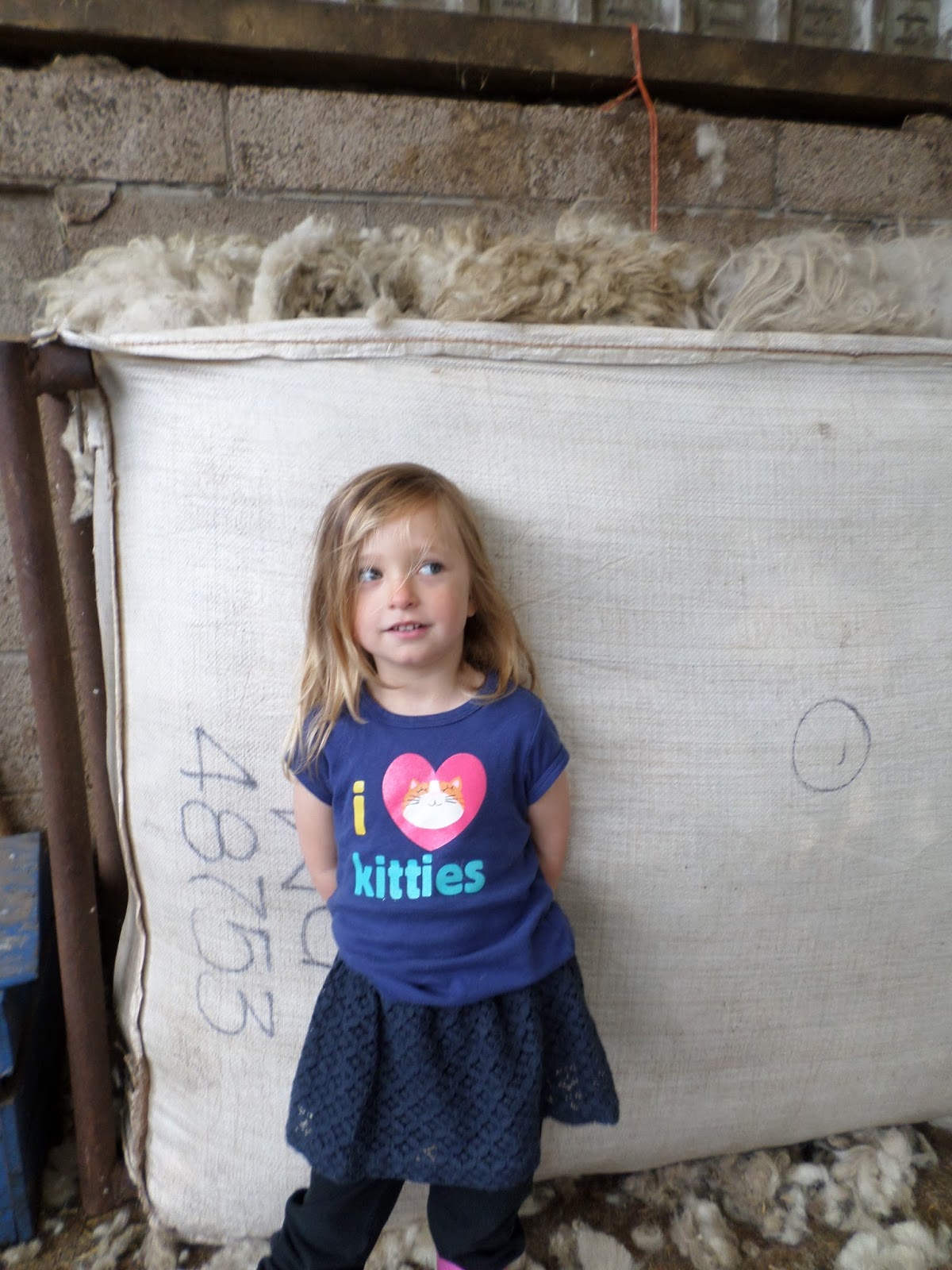
A nearly full bag of fleece: Three-year-old for scale
Mostly the system worked without a hitch.  Sheep were encouraged along, grabbed by shearers from the chute, sheared, then released, where they joined a newly shorn flock in the next holding area. Sometimes the sheep became scared enough to make a break for it, though, like this one, which jumped out of a holding pen and was chased down by the farm's sheep-herding dogs, Scott the farmer, and several other workers. 

Escapee being returned
Although the shearing process wasn't painful for the sheep, it did make them uneasy, mainly because it was out of the ordinary.  The gathered sheep were basically wild, interacting with humans only a few times a year.

After being sheared, the sheep weren't done yet.  When we visited Glenogil and Scott's farm, we were surprised to find out that these male sheep were not kept for wool or for meat, but rather as part of a clever integrated pest management scheme.  In Glenogil, the UK government values grouse, because people pay money to come shoot them.  But if the grouse get ticks, they become anemic and potentially die. And no grouse, no shooting income.  So Scott treats his hill sheep with insecticide.  The spray doesn't hurt the sheep, and when ticks attach to them (preferring big sheep to small grouse), they die. And the grouse are protected, to die in a more economically valuable way.  Scott's sheep protected 8,000 grouse last year, although this year due to a cooler climate, there were fewer grouse.

More waiting for the sheep
After shearing, the sheep were again gathered into a pen, to await the second part of their treatment.  The shearing keeps them healthy - if their fleece is just allowed to grow, they become susceptible to becoming breeding grounds for fly larvae.  So sheared sheep are more hygenic.  After waiting, the sheep were encouraged into another chute, this time for tagging, clipping, marking, and insecticide treatment.

Tagging the ears
Each ear got a tag, one of which had a radio frequency ID (RFID) chip in it.  So sheep were tagged, then scanned, so workers knew who was who. If the horns were too long they were clipped at this point too, although this was not too common, maybe one out of 20-30 sheep got its horns clipped.

Clipping horns that have gotten too long
Marking
The last steps for the sheep were marking (with orange Sheep Marking Fluid) and treatment with the insecticide.  It left a green trail down their back, but quickly soaked in to be invisible.

Insecticide treatment
Finaly, the sheep were relased into a final holding pen, which was where we came in.

Sheep in holding pen
As we drove out to Glenogil, I didn't know quite what to expect, other than I was going to see sheep.  But I walked away very impressed with what a massive undertaking running a farm is, and we barely scratched the surface.  We saw one day of one particular task - shearing and treating male blackface sheep - that was part of much larger web of interactions - grouse as a more valuable commodity than sheep,and  sheep as hillside pest control. 

Scott's farm is diverse - it's not just these male sheep.  There are female sheep, and cows (who will feature in another blog, more about local food) and crops like wheat and barley as well. It's a full-time, year-round job to keep the farm running, and in fact in addition to monitoring the shearing, Scott was also off (on one of his quads) periodically during the day we were there to monitor calving in another part of the farm.  Despite this, he patiently answered our many questions about the farm, and even let Claire check out his ride.

Checking out the quad with farmer Scott
I definitely learned a lot about the agricultural reality of Scotland by visiting Scott's farm in Glenogil - and I hope you now have as well.  

So, support your local farmer! 
Buy local food when you can! 
And never, unless you have received specialized training, attempt to shear a sheep!
Leave it to the professionals.

Sheep herding professionals at rest: Bye for now
 

Wednesday, July 1, 2015

Three Tips for Driving in the U.K., by Paul

Speed limit sign

Disclaimer: This blog should not be used as a subsitute for actual driving instruction in the U.K. Just in case you were considering it.

So we're embarking quite soon on our adventures with American visitors during this, our last Scottish summer.  Most are going to rent (ahem, hire) cars for some portion of their visit, so here are a few tips from Paul, the licensed U.K. driver.

Tip 1: The centre line should always be to your right. It will feel strange because you will be driving from the wrong side of the car, but if the centre line is to your right, you're OK.  Being aware of the centre line also may minimise youe chances of sideswiping parked cars on the side of the road.

One side note about those parked cars...if you're coming up a road that is, in theory, two lanes, but there are parked cars reducing it to one lane, look at which direction most the cars are facing.  If they're going the same direction as you, you should yield to oncoming traffic.  

Tip 2: Roundabouts are everywhere, so it's good to know how to drive through one. Stay to the left to go around the roundabout, even if you are turning right. The link below to the UK drivers Learners Guide offers quite a helpful quick guide to which lane you should be in coming into a roundabout, depending upong where you want to exit. The section is called, in a very British fashion, "Lane Discipline." Basiclally, look at the road to get guidance on which lane to be in (i.e., if you're going to Dundee, one of the lanes might actually have Dundee, or some abbreviation thereof, painted in it), and follow the rule of thumb that if you're turning right (taking the the third exit off the roundabout) you should stay in the inside lane, and signal your intentions (paradoxically, signalling left as your approach your turnoff).

Roundabouts can be complicated so pay attention to these signs on approach to see which exit to take.
Tip 3: Speed Limits. Speed limits are actually fairly fast, especially as you start driving and realize how narrow some of  the 60 mph roads are. You can go 70 mph on the motorway, and 60 mph on most other roads. When you approach a village/town that has streetlamps, however, you need to slow to 30 mph (the circular sign at the top of the blog, with the red border, is a speed limit sign).

   
The national speed limit is 60 mph, and in addition to perhaps seeing a red-bordered sign saying 60 to indicate that, you might also see this, which indicates the beginning of the national speed limit.

National Speed Limit sign (60 mph)
It's uncertain why rule-makers in the U.K. chose such a cryptic sign, but cheer up, you could be driving in Wales instead and not even be able to tell where you're going, thanks to Welsh spelling:

Welsh road sign
So happy driving in Scotland.  Despite some complicated roundabout signs, the general direction signs are quite vague, if somewhat reassuring...you might see a sign that gives the names of the two nearest towns, and then a helpful arrow pointing straight ahead, accompanied by the words, "To the North."  So, keep going North, and if you start seeing signs for Inverness and the A9, turn around and head back to Perth, where there is one roundabout to rule them all; you can go to any city in Scotland from it, including our lovely city of Dundee! 

Tuesday, June 23, 2015

Scotland: Cultural Differences Part 1

After nearly two years in Scotland, the cultural differences have become normal to us. But as I contemplate the American visitors who are coming to see us in this, our last summer in Scotland, I think about all the things that will seem very foreign to them. I tried to make a list of all the "cultural differences" topics that I talk about when people ask how things are different in America. It's definitely too long for one blog post. So, here is Cultural Differences, Part 1, not necessarily in order of "importance" but in order of how I thought of them, which is generally how I experience them in everday life, too! 

1. Cultural norms are different
This takes lots of forms.  The most obvious examples I've run into concern customer service, tidyness, supermarket layout, and the house/garden distinction.

Customer service, in the UK, is generally minimal. And it's not just me. British people agree with me on this one. This is true for corporations - one of Paul's favorite stories about our move is that when he called to set up Internet service, British Telecom (BT) told him it would take 3 weeks. He said something along the lines of "I'm going to call your competitor! (Sky) and the agent replied, "Go ahead, they use the same technicians we do, so your Internet is still going to take 3 weeks." Customer service in shops and restaurants also tends to be very low-key. Part of this (especially in restaurants) is likley because tipping is uncommon.  A 10% tip would be generous. This may be more Scotland than other parts of the U.K. (Scots do have a reputation for penny-pinching).  On the flip side, however, you can get very personal service because the U.K. is a small place (well, maybe except for London). People know you. So I've received a personal call from a local librarian to tell me that a book I ordered is in. Also a call (probably from that same librarian) to tell me my 5-year-old forgot her kittycat stuffed toy at the library. I've also watched the owner of a small post office/corner store come out from behind the counter and help a woman with mild dementia do her shopping, while 6 or 7 people waited patiently in line while he helped her.
  
The supermarket layout in the U.K. is mystifying.  It totally reminds you that you are not in the U.S. Two particularly puzzling examples are pancake syrup and straws. In the U.S., the syrup would be in the baking aisle, near the pancake mix, and the straws would be in the paper products aisle, near paper cups and napkins. But in the U.K., pancake syrup is in the dessert aisle (because pancakes are generally a dessert/sweet treat) and straws are with the party stuff (because, why would you have a straw if you weren't having a party?) Also, tissues. Again, with the paper products in the U.S., OR you could buy them in a drug store. Makes sense, right - you have a cold, you go to get cold medicine, and tissues. Not so in the U.K. No tissues to be had in the drug store. Drugs, yes. Feminine hygieine products, yes. Hair products, yes. But no tissues. The upside was that during my fruitless search for tissues, I ran into a friend I hadn't seen in a while.  She didn't seem to mind my runny nose.

Tisseus finally purchased at the supermarket, Tesco

Which brings me to...cleaning up after yourself, and your dog. I'm not saying that people in the U.K. are untidy. It's just aparently not as much of a cultural norm to pick up after yourself as it is in the U.S.  It starts early - I think Audrey is the only kid in her (first grade)  class who throws things into the trash bin in the schoolyard. It's just not expected.  If you go to a cafe, you leave your teacup and trash on the table. Someone will come clean it up. Audrey's school employs a janitor to pick up ofter the kids. And the local city government employs people to pick up the streets as well. You see them walking up and down the streets, wheeling along a trash bin and picking up everything that's left on the street. Except dog poo. Of which there is more than there should be. In the middle of highly traveled sidewalks. Big poo, small poo, what I have come to call "dog-a-rhea" for obvious reasons. Some people do pick up their dog's poo.  There are small bins for that purpose stuck to posts at regular intervals, and signs or stickers on the bins/posts to remind people that it's actually the law to pick up your dog poo in Scotland, but it doesn't seem to be changing anyone's mind. So watch where you step.
 
Speaking of stepping, you have to watch your step in people's houses, too, although not quite as literally.  In the U.S., if you invite someone to your home, it is likely that you will give them a tour of the house, especially if they have not visited you before. In Scotland this would be unheard of. If someone invites you to their home, you are expected to stay downstairs, probably in the kitchen, dining room, and living room. The only possible exceptions are if their only bathroom is upstairs (in which case you are allowed to visit it) and if they have kids (in which case the kids, if they are old enough not to destroy everything in their path, can go upstairs, but you should still ask before going to collect them from upstairs- it is likely that the Scottish person will bring them down rather than let you go up.)  Gardens, on the other hand, are a point of national pride.  You may be asked to visit a friend's garden and tour it, and you should be appropriately complimentary, as they have likely spent a lot of time getting it to its current lovely state.

Pond in my friend Frances' garden
2. Language is different
If you read this blog regularly you will have already read a lot about language, butI'll  just give it a few more words here, because it really is one of the big differences you notice as a foreigner.

First, British English has different words for almost everything.  And there are certain words that can lead to serious embarassment when used incorrectly.  Foremost among these words are pants and pumping.  If you are American, you're probably thinking...Pants. Pumping. Those words aren't very embarassing. One is something you wear when it's chilly outside, to keep your legs warm, and the other has multiple meanings - you can pump gas, or pump your legs on the swing to keep swinging higher and higher, especially if you're seven. But in the U.K., pants are underpants, so if you slip and say "I bought some new pants" people will titter.  This was absolutely the first language change made by the 5-year-old. "Mom, don't say pants! Say trousers!" Pumping in the U.K. means farting. So pumping on the swing takes on a whole new meaning (thank you to my three Scottish readers who are laughing right now).
 
Second, Scotland has accents in abundence.  I have written about this before but it's inescapable on the the ground. Once you start hearing the differences, you can detect Edinburgh (the mildest of the Scottish accents, at least among the educated Edinburgh folk I know. Sounds nearly English, but shhh, don't tell them, they'll be offended). Aberdeen sounds a bit like Scrooge McDuck (again, this is not a compliment, sorry people from Aberdeen).  Glaswegian is distinct from Dundonian, and then there's the Highland accent which is slightly more intelligible than the outlying islands, where the accent and the vocabulary are fairly different from anything you hear "on the mainland."  Plus throw in people who still retain and English accent or an Irish one after living in Scotland for some time. Everyone may have some common "Scots" dialect like saying "wee" for anything small, and (on the east coast) "bairns" for kids (there's a different word for the West coast but since I don't live there, I don't know what it is!)  But back to where I began this post; I just asked Paul to describe the Glaswegian accent, and he said "I don't know - whe we first got here I could hear it, but now I don't anymore." It's just normal.

This poster, courtesy of Wikimedia Commons, is probably one of the most common memes in Britain, When I Googled Scottish Accents to look for a good image, I got "Keep Calm and Love Scottish Accents" and "Keep Calm and Fake a Scottish Accent"
 

Sunday, June 7, 2015

Farm to Festival on 7 June

It's now officially summer in Scotland.  I can tell because the temperature has not dropped below 50 degrees (except for during high winds, like the past two days) and it's usually sunny for at least half the week. But, weather-related comments aside, it's summer because there are suddenly tons of things to do at the weekend. This weekend was no exception.  On Saturday, there was an outdoor "try it out" session for camps sponsored by the local government (Dundee City Council), but since winds were gusting up to 50 mph, we decided to go inside instead to dig up a dinosaur at the science centre, which was quite fun.  A staff member was showing fossils to the kids at one point, and she said "you'll never guess what this is a fossil of" and Claire said  "poo!" because she likes to say "poo" and it actually turned out to be dinosaur coprolites. So who knew.

Today we went to a farm for Open Farm Sunday this morning, and then to the West Fest Big Sunday on Magdalen Green (just outside our house) this afternoon. About the farm: we went there entirely because since coming to Scotland, I have become somewhat obsessed with sheep.  You see them everywhere (well, at least as soon as you leave the city) but they're usually at a distance - up the hillside as you drive, flashing by as white blobs as the train speeds past. And they're very cute.  Especially in April and May, when it's prime lamb season (aparently most are born in late March/early April). I was more involved in lamb season this year because our friend Stephen, from a Scottish farm family and aware of my sheep obsession, sent me a link to the "lamb cam" for the last week in March, so I could see (live) little lambs wobbling around in the evening.  It was super cute but it made me sad because it was sponsored by a company called Quality Meats. Hmm.

So, Open Farm Sunday.  The nearest farm to us that was open turned out to be the James Hutton Insitute, which is a research farm that investigates soil and crops. But in addition to farm tours, farm machinery to climb on, and plant science experiments and crafts, they advertised "Meet a sheep." I was there.


First the girls got ready. Overalls, of course, because they were farmers.


The sheep for meeting - a ewe and two lambs. I even got to pet them - the sheep-minder pointed out that the ewe had very coarse wool and if they were raised for wool, they would be "for carpet," not for wearing. The lambs were softer!


We took a tour of the research farm which was quite large and also beautiful - nothing but farmland, quaint village, and the river Tay as far as you could see.  Even some stone walls and hedgerows.


Next we got to climb on the farm machinery!


These were some big tractors

The wheel was as tall as me!

Fun in the tractor cab

Taken by Audrey of us in the Combine cab

Claire in the small Combine

Us in the big Combine

One of the glass houses

Someone taking after her mother with sheep obsession....

After the farm, and a brief break, we went on to the WestFest Big Sunday.  When we arrived, the traffic wardens were ticketing people who parked illegally.  But the good thing about this festival is that it took place 20 yards down the hill from our house, so no need for us to move the car.


This is what it looked like from the top of the hill. River Tay in the background. 


The beer garden. Note people looking suspiciously at me in the foreground for photographing the beer garden.
We made our way over to the msuic area, so this was the scene listening to a group we could best describe as "Scottish Bluegrass" - they had a fiddle, a banjo, a guitar, and a bass and were singing something about Kentucky with a distinct lilting cadence...


Finally, we stood in line for the main event - the grass sledging. Or, sliding down the hill on a little wheeled cart. You got to go three times for 1 pound - a good value except you had to spend almost 30 minutes waiting in line to get your 3 minutes of zooming down the hill.  The girls said it was worth it, though.


Happy Scottish Summer Kick-Off!

Wednesday, June 3, 2015

A Collection of Memos from my Phone

I started to write this blog on why Scotland is totally underrated as a tourist destination by Americans.  But half an hour in, it was starting to look more like a thesis than a blog post. So, moving on.

Sometimes when I am walking home from work, I think of something I want to blog about. So I stop and whip out my super-wimpy smartphone (it doesn't even merit a capital S) and click on the Memos icon.  I am still a fairly rudimentary texter, so my Memos are often mis-spelled, but my hope is that when I look at them later I'll be able to figure out, as the Brits say, "what I was on about." So here goes.

Memo 1: Blog on best toys.

Tad and that $3 cape I bought at Savers. Seriously, Tad, of Leapfrog fame, has got to be our most long-lasting toy.  My aunt gave him to us when Audrey was 18 months old. We started using him as her "going to sleep" music (he plays 10 minutes of night-time music if you sqeeze his hand twice) then, and he's still going. With only about 3 battery changes...we play him every night. He even goes on vacation with us. Audrey is now nearly 7. And the $3 cape. I bought it on a whim at Savers, the thrift department store in Rhode Island, when Audrey was about 4.  It's shiny green on one side and black on the reverse. It has been a princess cape, a fairy cape, and is currently serving as Hermione's cape from Harry Potter, complete with the Hogwarts "coat of arms" badge that I bought in London sewn on.   


Memo 2: Flying thru Amsterdam

My attempt to capture our flying trip through Amsterdam.  It was supposed to be an afternoon, maybe getting to see the Van Gogh museum. But thanks to airline delays, we got into the city in time to check into the hotel and seek out dinner. It was a cool city. We saw a stand with about 8 varieties of what Rhode Islanders would call "fried dough"  - mostly apple-based. There was a skating rink, but it was quite melted in places. Even in the north, the weather was too mild for an outdoor rink.  We also saw a big sculpture/place to take selfies written "I Am sterdam" - the letters were probably 8 feet tall but people were climbing all over them for pictures.  We ended up in a hotel on the 3rd (well, they call it the 3rd but counting the flights of stairs you would call it the 4th) floor having to open out windows to the December air because the heating was on full blast and we couldn't adjust it. 

Skating Rink/Swimming Pool

Selfies galore
Apple/Dough stand at the airport

Memo 3: Could you possibly...

A note to myself about the possibility of a blog about polite British ultimatums.  Stemming from my boss telling me that when she says, "Could you possibly..." to her teenage children, they jump up and do whatever she's asked, because that phrase is eqivalent to her saying, in American terms, "F-ing do it, or else!"

Memo 4: What the...

Notes about a possible blog (or blogs) about how the UK did not recognize us as having a life or history beyond its borders, and the parallels with a workshop I took on creating a fake identity (in the name of research, of course!).  In reality, all the steps the workshop runner explained for creating a fake identity were things I had done in the previous 6 months to establish myself as a legitimate person in Scotland.  The only difference was I had a letter from the University stating I was employed by them, which made me "legit" instead of "fake."

This memo was also about being culturally lost in the grocery store, and being intially unable in Dundee to find a store that sold tissues (hint, not the pharmacy) or basic office supplies (hint, the post office). But that while I was on my tissue hunt I ran into both my choir director and my boss. Typical small-town Dundee. 

Memo 5: More Amsterdam.

This memo was about how impressed I was in Amsterdam's Schiphol Airport to find that someone had designed a seating area with a built-in slide. Adults rest, kids climb the stairs and slide down over and over and over...brilliant!  Also in the same airport, I spotted a store called "Philosophy" - they really sell everything in airports nowadays. I almost bought slippers in the shape of wooden shoes. But I resisted. And for some reason I also remembered in this memo that it was snowing lightly when we visited L'Academia in Florence.  

Hope you have enjoyed this trip down Memo-y lane.