I will admit, since coming to Scotland I have become a bit sheep obsessed. They are seemingly everywhere as you travel around by car and by train, munching grass and giving much of the country a buccolic, pastoral atmosphere. They look so cute, especially in the early-lamb days of April and May.
 |
| Grazing sheep in Glenogil |
Being a digital researcher, however, I never had a reason to interact with sheep aside from viewing them as we zipped by in the car. But, being an (sheep-obsessed) anthropologist, I wanted to change that. Our friend Steven is the son of a farmer, and he introduced me to Scott, whose working farm is just up the road from Dundee. Scott mentioned that he was about to gather some sheep in for shearing in the 10 days after we met him, so I, jumping at a chance to interact with sheep up close, asked if I could come along. To my surprise, he agreed. And so, ten days later, after forty-five minutes driving into the pastoral wilderness with my husband and three-year-old (thank you, very patient husband and three-year-old, for humoring me), we were there, at Scott's farm in Glenogil, eye to eye with some uncertain sheep, and some confused workers who were too polite to ask us why we were standing around like tourists, watching them work.
Fortunately Scott arrived at that moment and shepherded us through the sheep enclosure and into the shed that was the sheep shearing staging ground. They had gathered approximately 1100 male blackface sheep from the hill the day before, starting "early" and finishing about 6 pm. Scott told us that they gather these sheep four times a year, and that they keep around1400 female sheep closer to home, although some of the "home" sheep go up the hill to join the "hill" sheep in summer. Since the sheep to be sheared had been gathered into the barn, the first step was getting them from the barn to the shearing shed.
 |
| Scott and his father encourage the sheep in the right direction |
The shearing team had arrived around 8 that morning - a team of three contractors who travel around to shear as needed. Although they were all experienced shearers, the lead guy competed in competitive sheep shearing as well - he was quite amazing to watch. Once the sheepwere in the shed, they were pushed into a series of small pens leading up to the shearing platform.
 |
| Waiting for shearing |
 |
| The chute |
To be sheared, sheep were encouraged up a narrow chute. There were three doors in the side of the chute, one for each shearer. When the shearer was ready, he opened the appropriate door, hauled out a sheep, positioned it and held it in place with one hand, while grabbing the electric razor and beginning to shear with the other hand.
 |
| Two shearers at work on the shearing platform |
Scottish friends asked if I had a go at shearing, and the answer was, after watching the shearers wrestle the sheep, I had no desire to try my completly amateur hand at what is clearly a trained professional job. I envisioned wool carnage, if not a sliced sheep leg (or my own hand). I am just not that strong, or coordinated. Have a look at this: the lead shearer, wrestling a sheep through the shearing dance, start to finish, in 1 minute:
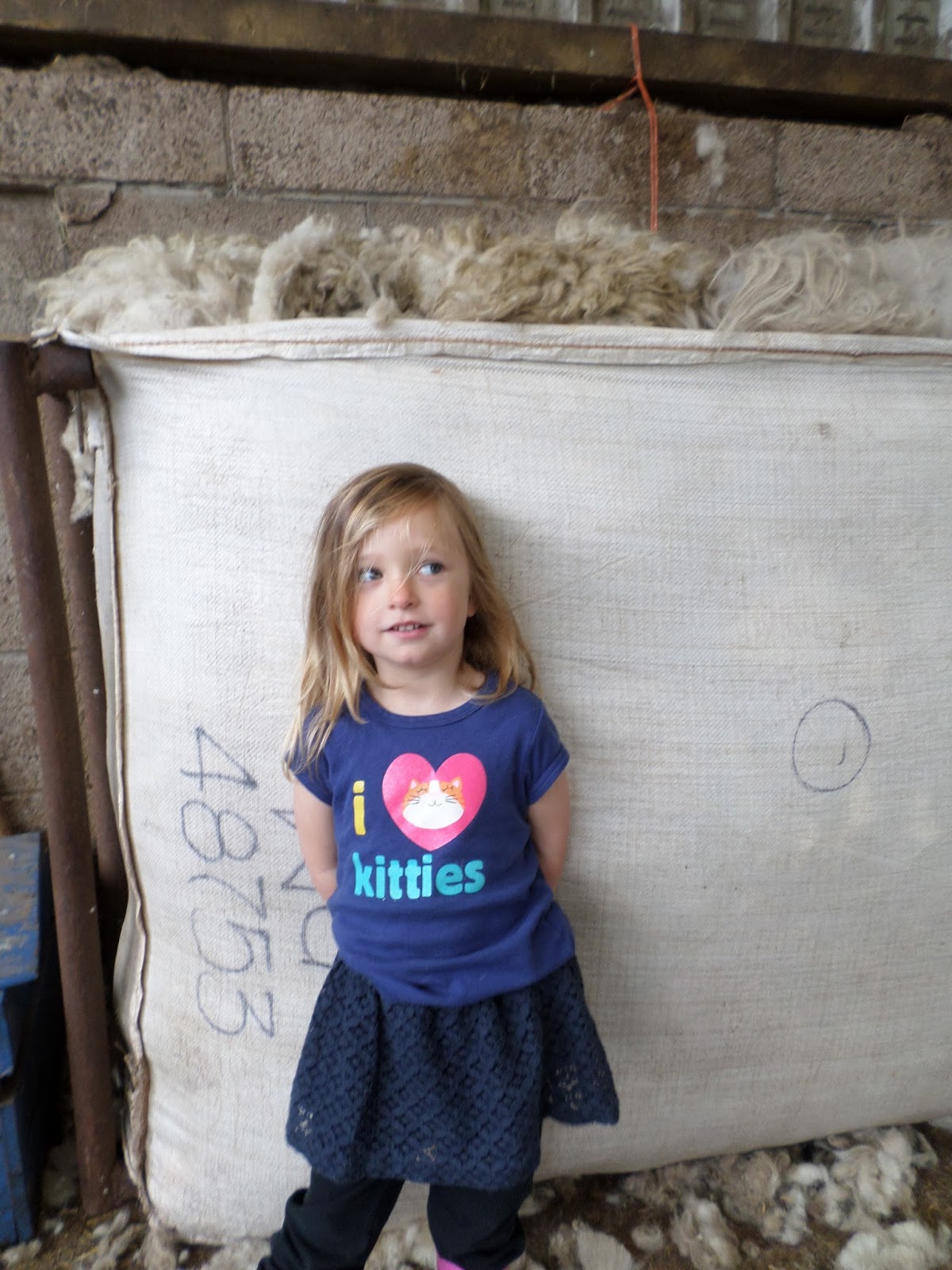
After the shearer fnished a sheep, he let it go, and it jumped off the plaform and scampered away. As in the video, someone gathered up the fleece and moved it out of the way, so the shearer could keep his rhythm going. This fleece-gathering was about the only job Paul and I were qualified to do here. It involved spreading out the fleece, rolling it up, and putting it in the bag of fleeces.
 |
| Finished sheep: note bag of fleece in the foreground |
 |
| Rolling the fleece |
 |
| Paul with his rolled fleece |
 |
| A nearly full bag of fleece: Three-year-old for scale |
Mostly the system worked without a hitch. Sheep were encouraged along, grabbed by shearers from the chute, sheared, then released, where they joined a newly shorn flock in the next holding area. Sometimes the sheep became scared enough to make a break for it, though, like this one, which jumped out of a holding pen and was chased down by the farm's sheep-herding dogs, Scott the farmer, and several other workers.
 |
| Escapee being returned |
Although the shearing process wasn't painful for the sheep, it did make them uneasy, mainly because it was out of the ordinary. The gathered sheep were basically wild, interacting with humans only a few times a year.
After being sheared, the sheep weren't done yet. When we visited Glenogil and Scott's farm, we were surprised to find out that these male sheep were not kept for wool or for meat, but rather as part of a clever integrated pest management scheme. In Glenogil, the UK government values grouse, because people pay money to come shoot them. But if the grouse get ticks, they become anemic and potentially die. And no grouse, no shooting income. So Scott treats his hill sheep with insecticide. The spray doesn't hurt the sheep, and when ticks attach to them (preferring big sheep to small grouse), they die. And the grouse are protected, to die in a more economically valuable way. Scott's sheep protected 8,000 grouse last year, although this year due to a cooler climate, there were fewer grouse.
 |
| More waiting for the sheep |
After shearing, the sheep were again gathered into a pen, to await the second part of their treatment. The shearing keeps them healthy - if their fleece is just allowed to grow, they become susceptible to becoming breeding grounds for fly larvae. So sheared sheep are more hygenic. After waiting, the sheep were encouraged into another chute, this time for tagging, clipping, marking, and insecticide treatment.
 |
| Tagging the ears |
Each ear got a tag, one of which had a radio frequency ID (RFID) chip in it. So sheep were tagged, then scanned, so workers knew who was who. If the horns were too long they were clipped at this point too, although this was not too common, maybe one out of 20-30 sheep got its horns clipped.
 |
| Clipping horns that have gotten too long |
 |
| Marking |
The last steps for the sheep were marking (with orange Sheep Marking Fluid) and treatment with the insecticide. It left a green trail down their back, but quickly soaked in to be invisible.
 |
| Insecticide treatment |
Finaly, the sheep were relased into a final holding pen, which was where we came in.
 |
| Sheep in holding pen |
As we drove out to Glenogil, I didn't know quite what to expect, other than I was going to see sheep. But I walked away very impressed with what a massive undertaking running a farm is, and we barely scratched the surface. We saw one day of one particular task - shearing and treating male blackface sheep - that was part of much larger web of interactions - grouse as a more valuable commodity than sheep,and sheep as hillside pest control.
Scott's farm is diverse - it's not just these male sheep. There are female sheep, and cows (who will feature in another blog, more about local food) and crops like wheat and barley as well. It's a full-time, year-round job to keep the farm running, and in fact in addition to monitoring the shearing, Scott was also off (on one of his quads) periodically during the day we were there to monitor calving in another part of the farm. Despite this, he patiently answered our many questions about the farm, and even let Claire check out his ride.
 |
| Checking out the quad with farmer Scott |
I definitely learned a lot about the agricultural reality of Scotland by visiting Scott's farm in Glenogil - and I hope you now have as well.
So, support your local farmer!
Buy local food when you can!
And never, unless you have received specialized training, attempt to shear a sheep!
Leave it to the professionals.
 |
| Sheep herding professionals at rest: Bye for now |