Sunday, March 2, 2014

Tales from the Train: Scotland and England


Compared with the US, Britain has a fabulous rail network.  You can get to places small and large by rail in Britain, far more than you can in the US, where your options are really limited to the Northeast corridor (Washington DC to Boston) and perhaps the odd train to Chicago.   Over the past two days, I have gotten to know the rail network much better, traveling from Dundee down to Nottingham for a quarterly research project meeting.  Over the course of two days, this has meant approximately 10 hours in the train, and thanks to travel agents who apparently didn’t both checking that we used the most efficient routes, a lot of changing trains. I don’t really have sour grapes about this – we made all the changes with relatively little effort, as it was just myself and my boss, Wendy, traveling (with the addition of our colleague Mike from Edinburgh on the way back). But here is the synopsis of our travel (with the long, boring parts removed for readability).

10 am Thursday: we are on the platform at the Dundee station, drinking tea and coffee and eating pastries.   The weather is sunny – if you stand in just the right place on the platform, the sun filters down from the street above and warms you up.  I am amused by a sign posted on the platform encouraging people to clean up after their dogs – something Dundee citizens need to be reminded of, given the frequency with which I run across dog poop on the street, left as a little present to passer-by. 


photo of sign about cleaning up after dog
Until they have their own toilet...priceless.


The day’s journey starts smoothly, and then we begin the string of train changes.  First in Edinburgh, then in Newcastle, then in Sheffield, then finally arriving to Nottingham close to 5 pm.  Not too tiring – we have managed to read and work pretty much the whole way. We walk around the corner to the ticket office on Nottingham (literally, around the corner, since the whole station is under construction) to see if we can get better seats for the train home the next day.  The ticket agent says, “it’s a good thing you stopped in” because the time of our train has been moved up 10 minutes, due to a landslide and poor track conditions near Sheffield, with no notification to us.  Good thing we did stop in.  She can’t really help us with the seats, only about to give us a different seat for the very last leg of our journey – Edinburgh to Dundee. Before hopping in a taxi, we stop in at the sweet shop to buy some “sweeties” for the kids in Scotland.

After the meeting the next day, taxis arrive slightly earlier to get us to the train station on time.  Although things are only a few miles apart in Nottingham, it seems to take 20 or 30 minutes to get anywhere, sitting in traffic for an interminable amount of time, waiting to turn right across traffic, taking many detours that seem to point us away from the station, until we finally arrive.  I am in a mild panic, thinking it’s nearly time for the train, but in fact it’s only 16:16 and the train doesn’t depart until 16:38.  As the time for the train draws closer (16:37 and still no sign of the train arriving on the platform) the number of people waiting grows, and we realize that because of the track problems, they’ve put two trains-worth of passengers of one train, and any hope of having a reserved seat flies out the window. We muscle our way on and grab a seat, leaving the unlucky Nottingham students to stand. Although we leave late, we make up enough time to catch our connection at Sheffield – even having to a wait a bit for it, time to take a picture of the Victorian bar, the Sheffield Tap, a World Beer Free House – not, Wendy explains, that the beer is free, but that the bar is not connected with any particular brewery and can serve whichever brands it pleases. 
Sheffield Tap, a Victorian bar in the rail station.
Colleagues Wendy and Mike waiting for the train in Sheffield.

 Our train arrives and we board, finding our seats in the front coach (coach F…not the most intuitive one to put first, but I spy the letter as it goes flying past, leaving us scurrying up the platform to board). This a long haul. After the first train, I am ready to be home. Forget flying cars – I want to skip straight to teleportation.  We stay on the train for a long time. I finish my book, and we are still an hour and a half from Edinburgh. To make matters worse, the train is slow – 12 minutes slow, to be precise, shaving our comfortable 10-12 minutes change time at Edinburgh to a perilous 6 minutes or less. If we don’t make the 21:40 train, there’s another on at 22:08 but it’s the “milk run” – stopping at every podunk station between Edinburgh and Dundee. C’mon train, speed up! Just a few minutes will make a difference between making or missing that connection. A few minutes, and the luck of where the trains happen to be parked…if we step off one and just have to cross the platform to the other…       

Divine intervention – and the nicest train conductor ever…intervene. They identify eight or nine passengers (including Wendy and I) hoping against hope that we can make the connection to the 21:40 train.  Although we’re due to arrive at 21:35, the conductor talks to Edinburgh Waverly and gets us a track as close to the departing Aberdeen train as possible. They also talk to the other train and they agree to hold the train for 2 minutes. The conductor gathers us all in the end of the First Class carriage and gives us directions on how to go from track 11 to track 15, and says maybe the staff will even open the ticket barriers for us. We pull into the station, and Wendy says “Ready, set, go!” The first man opens the door and sprints out of the train, followed closely by the other 7 or 8 of us. We run flat out across the platform, crossing the road in front a bewildered taxi driver, not used to seeing eight or nine people dashing across his path, even at the train station. We race toward the ticket barrier, and the staff open up the handicapped gate, allowing us all to flow through at top speed.  “The end of the platform for Aberdeen” they yell helpfully, as we dash pell-mell down platform 15, finally reaching the still-open door of the train. We pile in, breathless. I was tired before, but now I am awake. We made it! After catching our breath, I enquire what carriage we are currently in, and realize our carriage is just one up, so we walk through and sit down just a half a minute before the train departs from the station. And the boredom resumes. But only for another hour.  And then I don’t have to take a long train journey for another month….    

Thursday, February 20, 2014

What's Up, Scotland? Deodorant and Tissues

Despite my mother's suggestion to write about crisps (or, potato chips), a trip to the pharmacy and an order from Tesco so shocked my American sensibilities that I feel obligated to do a post on, yes, deodorant and tissues.

Preparing for a flight to London a few months back, I found myself in the pharmacy looking for a travel size deodorant.  This raised several problems, not least of which was I know (thank you, continual TSA education) that you're not allowed to travel with liquids in containers of more than 4 ounces, but (not surprisingly) none of the containers in the UK were labeled in ounces, only milliliters. And I have no idea how to convert ounces to milliliters.  Besides this milliliters to ounces problem, I was struck by the fact that all the deodorants seemed to be competing to be awarded the title "longest lasting."  Now, if your target audience is teenage boys, it might be seen as an advantage to only have to re-apply your deodorant every 72 hours. But personally, I am wary of products that boast 48 or 72 hours of effectiveness. It seems like you should apply deodorant at least once per day to achieve acceptable hygiene.  But maybe that's my American sensibilities talking.  When Paul ran out of deodorant, I looked for a "short acting" formulation - something you might apply once a day, but the best I could find in our local Boots was the 48-hour version:

Dove Men+Care Antiperspirant deodorant
 My other concern has been with tissues.  In the US, tissues do vary.  You can get ones with aloe in them, or you can get them in rectangular boxes or small cubes. You can perhaps even get an "extra-strong" variety. But here in Scotland they have a kind of tissues I've never seen in the US. they are called "Man-Sized" tissues. Now, my background is in biological anthropology, and studying sexual dimorphism in modern humans will tell you men are indeed a bit bigger than women.  Probably if you take the time to measure, you will find that men have slightly larger noses, on average, than women.  But these man-sized tissues are ridiculous.  They are about 1/3 wider and 1/4 longer than normal sized tissues, or, to put in in perspective, about the size of my 2 1/2 year old's head. When I ordered them from Tesco (note: we do online shopping and delivery from the big Tesco in town: super convenient, except you can't really gauge the size of things you are buying when everything is in grams and you're not used to measuring that way - I accidentally bought really tiny amounts of cheese and a personal-size pizza when trying to buy larger quantities.) I thought at least the man-sized tissues might be more robust. But no.  Just inanely bigger.  My main feeling when I am using a man-sized tissue is "Man, a lot of this tissue is going to waste here." Thank you for attending to my rant. Back to other topics soon.  
Man-sized tissues, with regular sized ones for comparison


Thursday, January 30, 2014

Thank You Asli! Turkish Delights By Post

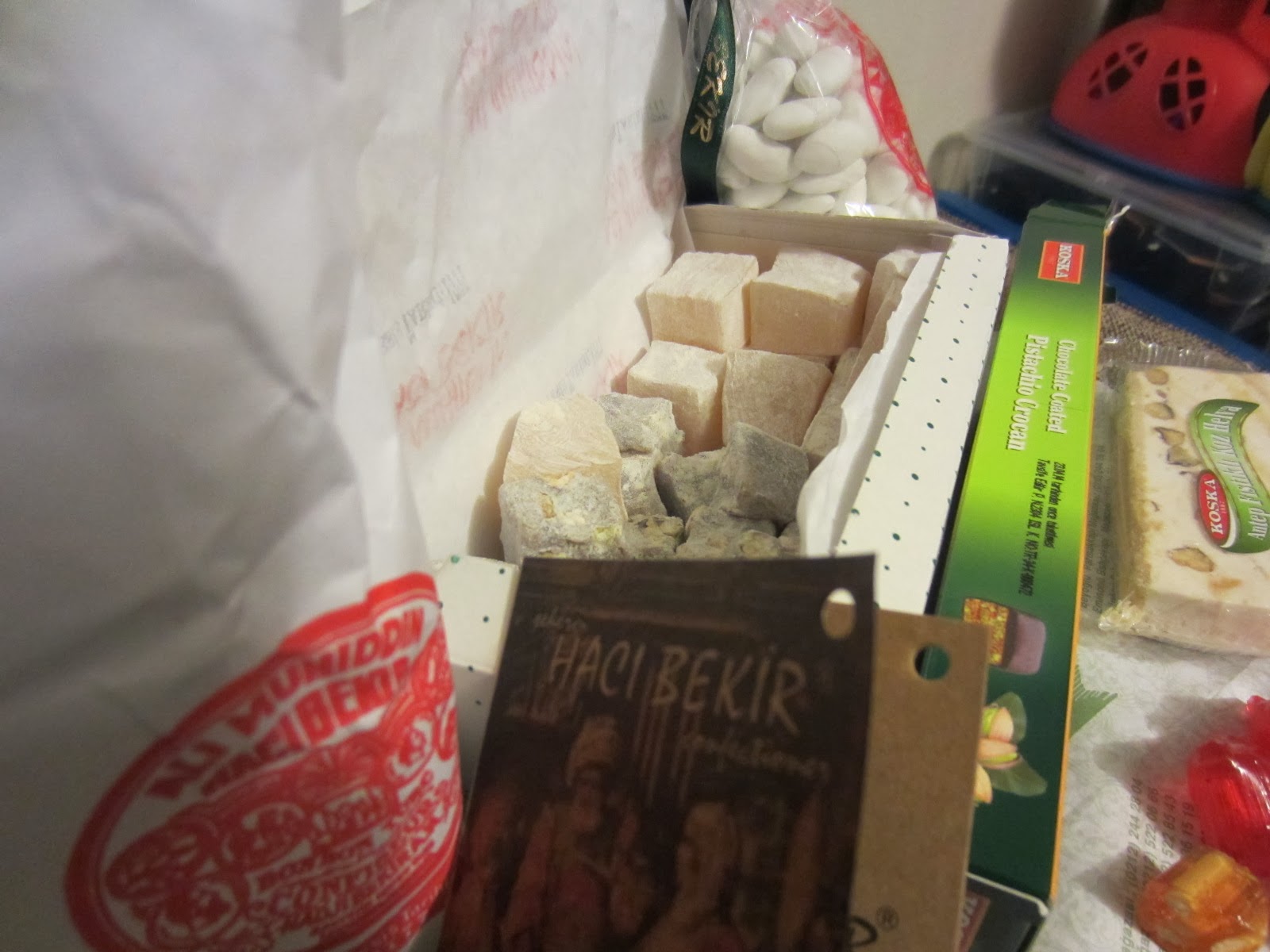
 So I arrived home from work today, and Paul said, "Your Turkish delight arrived today, and you owe Asli a very nice thank-you note because she sent a lot more than that!" So: a full blog post to say thank you!

Some of you may remember me complaining about the British version of Turkish delight in a Facebook status (although the ladies in my singing group tell me I haven't given it a fair chance, having only tried the "raspberry goo" flavor - there are apparently others). Anyway, Asli's response to my complaint was to say, "give me your address in Scotland, I'll send you some real Turkish delight." So what could I do? I gave her my address and cautioned her about the vagaries of Royal Mail (stopping anything that seems to be worth more than a few dollars, or pounds, or in this case lira.) She assured me she was a mailing pro.

 So today, I come home and there it is, a veritable Turkish confectionery feast. Two flavors of Turkish Delight (raspberry-ish with pistachios, and something Paul and Audrey claim is ginger, but I think might be "plain"?) that are both yummy (Paul says "Like a gummy. But a really GOOD gummy.") In addition, candy almonds (in the US we would call them Jordan Almonds but I guess Turks would not call them that). Plus chocolate-coated pistachio-something. Plus a wafer-y pistachio thing. Plus three kinds of hard candy, one of which is cinnamon and two of which I haven't tried yet, though Paul says the yellow one with the inclusions (nougat? I say, but he says no) is his favorite.

Audrey (5) liked the pistachio Turkish Delight. Claire (2) preferred the maybe-it's-plain-or-ginger flavor. We didn't show them the other treats...yet.

So thank you, Asli. you have definitely changed my mind about Turkish delight, and at the same time made me want to come visit Turkey even more than I already did (although Paul told Audrey that Turkey is where all the turkeys come from so she may be somewhat disappointed if we make it there and there aren't a lot of gobbling fowl about).

I want to close with one word about the power of Facebook. I currently research technology and social media and there is much hue and cry about how Facebook is declining with teens (and intimating that it is declining overall). But if I didn't have a connection to Asli on Facebook, my lament about Turkish delight would have fallen on deaf ears (or at least the ears of people who didn't know what I was talking about) instead of turning into a delicious Turkish confectionery surprise for all of us!  

Tuesday, January 28, 2014

Burns Night: 25 January 2014

Burns Night: Not a Holiday Celebrated (much) by Americans. Why? It celebrates famous Scottish poet Robert Burns (also known as Rabbie Burns), and the eating of haggis. So of course we had to try it - both the poetry and the famous dish.  According to Wikipedia, haggis is "a savoury pudding containing sheep's pluck(heart, liver and lungs); minced with onion, oatmeal, suet, spices, and salt, mixed with stock, and traditionally encased in the animal's stomach and simmered for approximately three hours." It's traditionally served with "neeps and tatties" AKA turnips and mashed potatoes. It also comes in a vegetarian version (more oatmeal, no sheep pluck).

Paul goes to a toddler group (appropriately called "Wee Rascals") at St. Peters Church just up the road from us, so we went along to their Burns Night celebration. The program is to the left above.  

After the welcome and a bit of singing, the haggis was "piped in" - by a bagpipe recording, not an actual bagpiper.  The presenter then recited Burns' Address to a Haggis (part of which is captured in the video below).  Although there were no bagpipes, there were men in kilts present, including Chris, below. He gave me a brief kilt regalia primer.

  His kilt is not made of a clan tartan - only the Highlands have clans, and he's from the Lowlands.  The Lowlands have "districts" instead, so his district is Roxburgh. As he told me, the jumper he was wearing "was not traditional" but he pointed out the "Jacobite" shirt worn by the presenter who did the "Address to a Haggis" poem (see video) and the "Prince Charlie" jacket worn by another attendee, the top to a formal kilt ensemble (below right: note, this is a picture from the web, not another dinner attendee :-)  Chris also pointed out that when the English banned kilts (but not tartan), the Scots took to wearing tartan trousers, called "Tartan Trews" that look something like the trousers below: 


But, beyond what people were wearing and the piping in of the haggis...I know the question is on your mind - what did the haggis taste like? 

Well, I only ate the vegetarian version. And that tastes a little like a black bean burger. The spice is a little different, but that's the general idea. Paul says, "well, it's internal organs, so that's a tough one. It's kind of spicy, but it's internal organs so it has kind of a tang to it. I can't really describe it."  So maybe a few pictures will equal 1000 words.


Vegetarian haggis with neeps and tatties
Regular haggis, for comparison


Paul enjoying haggis
  After the food was the entertainment: comic singing, more poetry reading (not Burns this time), Scottish dancing.  There was more, but it was bedtime so I dragged Audrey away from the White Elephant auction (though they simply called it "the Auction"). Paul and Claire had already retired, even before the dancing.  The video below shows a few highlights of the night - apologies for the shaky video of the Address (Claire was grabbing my arm, and you can hear her vrooming her toy car around on the high chair next to me :-) In case you can't understand the presenter reciting the Address, here is what he is saying (although seeing it printed may not be that much help).  Full text at the Robert Burns Country site.

His knife see rustic Labour dight,
An' cut you up wi' ready sleight,
Trenching your gushing entrails bright,
Like ony ditch;
And then, O what a glorious sight,
Warm-reekin', rich!

Then, horn for horn, they stretch an' strive:
Deil tak the hindmost! on they drive,
Till a' their weel-swall'd kytes belyve
Are bent like drums; 


Friday, January 17, 2014

About Scottish Christmas Decorations


So today I'm taking a break from the "What's Up Scots?" series to reflect on Scottish Christmas decorations.  I don't mean the decorations that graced the Dundee city centre and the West End for more than a month, though they were quite nice and made me feel festive every time I walked past the lit-up trees or banners.  

Tree in city centre, Dundee
Decorations in city centre, Dundee


 What I really want to talk about are two specific Scottish decorations, one of which was sent to us here in Dundee all the way from America (I know, we call it the United States, but everyone I talk to here says "America" although I have yet to test whether this usage refers to just the U.S. or all of North (and possibly South) America). That decoration is the Bagpiping Santa.  I like the Bagpiping Santa.  He was not made in Scotland, I am almost certain. And I really don't see all that many bagpipers, except in the touristy parts of Edinburgh, or on special occasions here in Dundee.  My boss' son is a piper, so we may even have a higher bagpiper-quotient that typical Scots. But there is a bagpipe song called "Bonnie Dundee." In fact, Americans may even recognize this song - it sounds, to me, like what the stereotypical "playing bagpipes" sounds like. This is a Youtube video of a piper playing Bonnie Dundee on the bagpipes. Based on his shirt, he Glaswegian instead of Dundonian, but we won't hold that against him.  Anyway, Bagpiping Santa is not only nice to look at, he reminds me of Scotland and its traditions, and I'm sure he will continue to do so after we return to America, and each year we'll take Bagpiping Santa out of the box and display him somewhere, and say to the girls, "Do you remember when we lived in Scotland?" Audrey might - Claire, who knows. But we'll have Bagpiping Santa to remind her.
Bagpiping Santa

The second decoration I want to talk about is the knitted Christmas pudding.  I had been looking around for a truly Scottish Christmas decoration, and I didn't find it. But, at Edinburgh Castle after Christmas, I did find a decoration that was at least made in England, and that was something I wouldn't be able to find in America - namely, a Christmas pudding.
Knitted Christmas Pudding
I still have not quite grasped the concept of a pudding. It kind of means "dessert" as in, "What are we having for pudding?" But it also refers to a specific kind of dessert that I would classify as a cupcake, or maybe something like a Chocolate Lava Cake, with the chocolate syrup inside the cake (at least this is what the Tesco microwavable pudding I got was like).  Confusingly, pudding can also be a meat dish, something you eat with breakfast (red or black pudding) or, according to "All Recipes UK," a boiled dessert that may also be called a "Clootie Dumpling."  Which you can also apparently make in the microwave.  "Microwave Scottish Traditional Food" is going to be a subsequent blog,around Burns Day, because I also have heard about....wait for it...microwavable Haggis. 

Anyway, the knitted Christmas pudding will bring to mind all of this whenever I hang it on the tree, as well as what the knitted pudding makes Paul think of, which is also prevalent in Dundee, left by dogs on the sidewalks (with no cherry on top.) I leave it to your imagination.  


Wednesday, January 15, 2014

What's Up, Scots? Sweeties and Biscuits!

Tunnock's Biscuits: Scottish and delicious


After the surprising success of my Facebook post of a scone with butter and jam, I've decided to move straight into sweeties and biscuits for my next post.  For the American audience, a sweetie is any kind of candy (chocolate or hard candy) although when our kids say "Can I have a sweetie?" they usually mean the chocolate kind.  Biscuits are what Americans call cookies, so I guess the Tunnocks tea cakes above aren't strictly "biscuits."  I started my sweeties and biscuits "research project" almost on arrival in Scotland.  I was helped on the biscuit end by a link my mother sent me, something along the lines of "Best British Biscuits" which of course I now cannot locate on Facebook.  It was this document that led to me buying and trying some common British biscuits like Bourbon Cremes (not really bourbon at all, but a chocolate biscuit with a chocolate centre), Custard Cremes (again, not custard, just a vanilla - or maybe lemon, it's been a while since I tried them - version of a Bourbon Creme).  I also tried Jammy Dodgers, which also come under different names - a vanilla cookie with raspberry jelly in the middle.  Although friend Amanda on Facebook was enthusiastic about Wine Gums, I have not yet tried them, although they are available as a movie-theatre candy at our local art house theatre (Dundee Contemporary Arts).  All the above-mentioned biscuits are available at local markets like Tesco or even Nisa (which is halfway between a supermarket and a convenience store in terms of size and selection).  I have also become a fan of chocolate digestive biscuits, sometimes called Hobnobs, but more properly made by McVities.
McVities's dark chocolate digestives

The dark chocolate digestives are best - a bit like a graham cracker with a chocolate side. I tried serving them to my interviewees, but didn't get any takers; a few people later told me they are more like "granny biscuits" (ie, what your granny would serve to you, not what you would choose yourself).  But I still like them, and they serve them at church, much to Claire's delight - we walk into the church hall and she starts saying, "Can I have a chocolate biscuit?"  Plain shortbread is also tasty too, and Paul's favorite thus far of the biscuits I have brought home for the family to try. I'm also partial to the Cadbury Fingers, which are thin shortbread "fingers" coated in chocolate. Okay, running out of time...More Sweeties will have to be the next post!   

Saturday, January 11, 2014

What's Up, Scots? Post 1: Castles

This is a castle. Yes, it looks like a large, somewhat Bavarian (says Paul, who's never been to Bavaria or even Germany for that matter) house. But it's really "Dudhope Castle" in Dudhope Park in Dundee. And it is the beginning of my series of posts I'm calling "What's Up, Scots?"  (Sort of a play on "What's Up, Doc?" but if I have to explain it, oh well.)

This What's Up is actually not too typical - more often, I find myself asking "what's up" in the context of food - things that aren't available widely, if at all, in Scotland, that I totally took for granted in the U.S. (like black beans, or chicken noodle soup!) But this What's Up stems from conversations with Paul about the American mental picture associated with the word "castle."  Maybe Scots and Europeans in general have a different mental picture, but a castle, to us, is made of stone. It has turrets, perhaps, or even a moat. Okay, it doesn't have to be Neuschwanstein, although that is an awesome-looking castle (and is probably awesome inside as well, I have visited years ago but can honestly say I don't remember anything about it except that it's on a hill. A BIG hill). 


Like this, maybe: Bodiam Castle in East Sussex, UK. I just mapped it and it's way down south, but if we ever find ourselves in the vicinity of Hastings, maybe we can stop by!

10 of the best: castles: Bodiam Castle, East Sussex

More likely we can pursue the authentic-looking castle in Aberdeen...Balmoral Castle, although it still presents a quandry - although it's called a castle and looks the part, at least turret-wise, the promotional material describes it as "a large estate house."


Which takes us right back to the house-like Dudhope Castle, or even the collection of buildings on a hill that goes by the famous name of Edinburgh Castle!

Coming up next (and my New Year's Resolution is to blog more often, so it may actually be soon) - What's Up considers other pressing matters, probably involving biscuits/cookies.